What Will Dissolve a Tree Stump Fast in Maitland?
Before you drill holes and pour anything into that stump, here is how each method actually works and what it does to your yard.
What will dissolve a tree stump fast?
Nothing truly dissolves a tree stump fast. Potassium nitrate stump removers speed up rot, but they still take weeks to months before the wood is soft enough to break apart. If you want the stump gone in an afternoon, grinding is the only quick method, and it avoids the fire and chemical risks of shortcuts.
How do chemical stump removers work, and why are they slow?
Most stump remover granules sold at hardware stores are potassium nitrate. They do not eat wood. The nitrogen feeds the fungi and bacteria that already break down dead wood, so the stump rots faster than it would on its own.
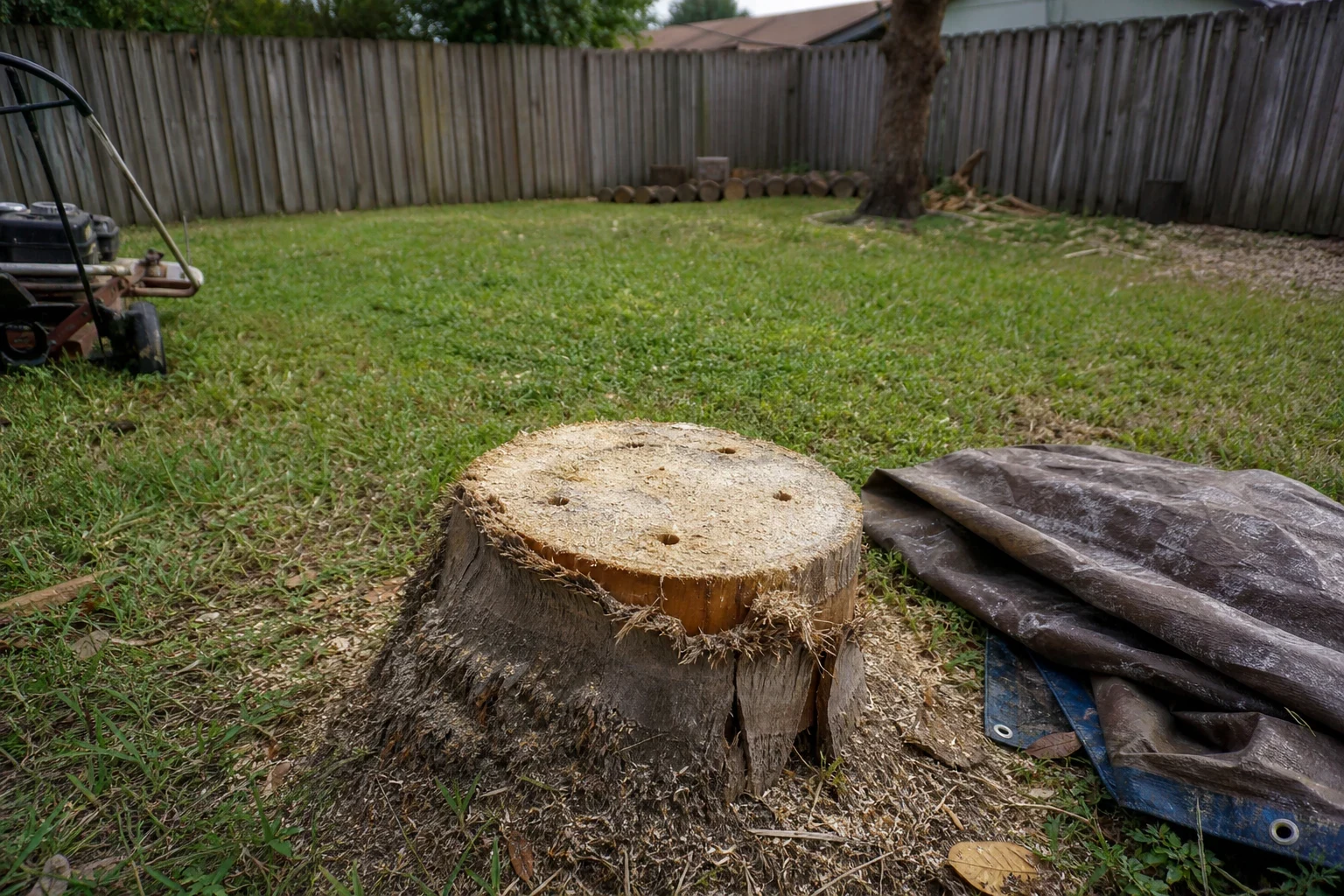
The usual method is to drill holes about an inch wide and 8 to 12 inches deep across the top of the stump, plus a few angled holes into the sides. You fill the holes with granules, add water, and cover the stump with a tarp to hold in moisture. Then you wait, usually several weeks at minimum, and often longer for dense hardwoods like oak.
At the end, the wood is spongy, not gone. You still have to chop it out with an axe or mattock, and the larger roots below grade keep rotting slowly for years. Central Florida heat and humidity help the fungi along, but a large stump still takes time.
Is it safe to burn a stump or use household products?
This is where most of the risk comes in. Potassium nitrate is an oxidizer, which is why some guides tell you to soak the treated stump with kerosene and set it on fire. A smoldering stump can burn underground along the roots for days, travel toward a fence, shed or dry mulch bed, and reignite after you think it is out. Many Florida communities restrict or ban open burning in residential areas, so check the rules before you even consider it.
Other common shortcuts either do very little or cause new problems in your yard:
- Kerosene, diesel or gasoline: fire hazard, contaminates the soil, and can leach toward nearby plant roots and sandy groundwater.
- Bleach: does not soften wood and damages the surrounding soil life you need for decay.
- Rock salt: can kill the stump's sprouts but also burns the lawn and beds around it, and it lingers in the soil.
- Epsom salt: dries out living roots to stop resprouting, but it does almost nothing to speed decay.
- Any treated stump: keep children and pets away from the drilled holes and loose granules, and store the product sealed and off the ground.
Are palm stumps different from hardwood stumps?
Yes, and it changes the answer. Palms are monocots. They have no bark and no cambium layer like an oak or maple, so a cut palm stump will not send up new shoots. The trunk is a dense bundle of fibers rather than solid wood, and the root system is a mass of thin roots from the base instead of thick lateral roots.
That means a palm stump usually rots in place faster than a hardwood stump of the same width, and chemical treatments add little. The fibrous trunk also clogs some hand tools, which frustrates people trying to chop it out. Grinding handles palm fiber well and leaves the area ready to replant. If the palm is still standing, our palm tree pruning and removal crew can take it down and grind the stump.
What is the fastest safe way to get rid of a stump?
Stump grinding. A grinder uses a spinning wheel fitted with carbide teeth to chew the stump into chips, usually down to several inches below the soil surface. Most residential stumps take well under a day, and there is no open flame and nothing poured into your soil.
Before any grinding, Florida law requires a call to Sunshine 811 so buried utility lines get marked. Irrigation lines and sprinkler heads are not marked by 811, so we look for them and flag them before the grinder starts. During the work, we keep people and pets well back, because a grinder throws chips and small stones. Afterward, the hole can be filled with topsoil and covered with sod or a planting bed. Our sod installation and mulch and beds services can finish the spot so it matches the rest of the yard.
Should you just leave the stump to rot?
You can, and in our warm, wet summers a small stump may break down within a few years. A large oak or camphor stump can take much longer. While it sits there, it is a tripping hazard, a mower obstacle, and in some species a source of new sprouts you will keep cutting back.
A rotting stump close to your home also deserves attention. Decaying wood in contact with soil can draw subterranean termites, and a stump near the foundation gives them a food source right next to the house. If the stump is within a few feet of the slab, removing it is usually the safer choice.
More questions about stump removal
- Will stump remover hurt my other trees or lawn?
- Potassium nitrate used as directed mostly stays in the stump, but spills and runoff can feed weeds or stress nearby turf. Roots grafted to a neighboring tree of the same species can carry some chemicals between them, so be cautious near similar trees.
- Can I plant in the same spot after grinding?
- Yes, once the chips are pulled out and replaced with topsoil. Leaving a deep layer of fresh wood chips can tie up nitrogen in the soil and stunt grass or new plants for a season.
- How big a hole does stump grinding leave?
- The hole is roughly the width of the stump plus its visible root flare. We rake out the chips, backfill with soil, and level it so it is safe to walk and mow over.

Get the stump out without the fire risk
Tell us about the stump on the phone, whether it is a palm, an oak or something else, and we will set up a free estimate. We check for utilities and irrigation lines first, then explain how grinding and cleanup would go for your yard.